RFC-8: Collections#
Adding groupings of images and other objects to OME-Zarr.
Status#
This proposal is early. Status: D1
Name |
GitHub Handle |
Institution |
Date |
Status |
|---|---|---|---|---|
Norman Rzepka |
scalable minds |
2024-11-20 |
Author |
|
Eric Perlman |
Yikes LLC |
2024-11-20 |
Author |
|
Joel Lüthi |
BioVisionCenter Zurich |
2024-11-20 |
Author |
|
Lorenzo Cerrone |
BioVisionCenter Zurich |
2024-11-20 |
Author |
|
Johannes Soltwedel |
German BioImaging e.V. |
2025-10-28 |
Author |
|
Christian Tischer |
EMBL |
2025-02-01 |
Author |
|
Matthew Hartley |
EMBL-EBI |
2025-05-05 |
Author |
Overview#
This proposal adds a new “collection” concept to OME-Zarr.
Collections can be used to group together images, including segmentations, prediction maps and other derived images as well as other data types (“nodes”).
Collections can be nested.
Collections can have metadata attached. Within collections, nodes can also have metadata, which complements or overrides the nodes’ own metadata.
Nodes within collections are referenced by paths instead of relying on a file system hierarchy. Paths may also be absolute and point to remote storage.
This proposal does not aim to invent new concepts, but unify approaches that the community has already adopted, in a standards-compliant and extensible manner.
Background#
The Why#
Viewing. Many viewers need to visualize multiple images at the same time. There is no generic way of defining this group of images.
Discoverability. Zarr doesn’t have a way of discovering groups within a group, which requires file system scans to discover images within a group.
Unifying concepts. OME-Zarr has a few collection types already, e.g. high-content screening, bioformats2raw.layout. This is an opportunity to unify them.
Extensibility. OME-Zarr does not have representations for adding other objects, e.g. tables, meshes, to a hierarchy. Through new metadata, collections offer a path to add new object types.
Metadata. Collections allow attaching metadata to images or other objects without altering the original object (think: overriding). While this proposal does not specify the semantics of such metadata, it provides means for storing them.
User stories#
1. Visualize multiple images at once#
Several viewers are capable of visualizing multiple images, that can map to a common coordinate space, at once. Examples are Webknossos, Neuroglancer, MoBIE and OMERO.figure. All of these tools have developed their own JSON-based metadata to combine multiple images in a collection, see “Prior art and references”. In addition to mere path references of the images, this metadata also contains information about coordinate transforms and rendering settings.
As there is no standard-compliant way in OME-Zarr to describe multiple images in one entity, users need to copy multiple links to interoperably visualize multiple images.
RFC-5 introduced the scene metadata, which partially solved this issue.
However, with this proposal we aim to embed it in a more flexible collection mechanism.
2. m:n segmentations#
While OME-Zarr has support for attaching labels to images, the support is not sufficient for many use cases. There are multiple label images that can be attached to a single image. This is a 1:n relationship. However, m:n relationships would be desired because labels might be related to multiple images. Examples for that are:
Multiple correlated images express the same feature that is being labeled.
Channels are stored in multiple images instead of in the same image.
Additionally, there are other types of derived images, such as prediction maps, which cannot currently be represented by OME-Zarr. In comparison to label maps, where each voxel is assigned a discrete ID, prediction maps have a channel per segmentation class (or similar) and each voxel is assigned a probability or other continuous value.
3. Shallow copies of images with segmentations#
Many workflow engines operate by taking input images and producing output images. In many cases, it is desired to keep the input images unchanged. Let’s assume the example of a pixel classification task. This task would take an OME-Zarr image as input and produce a prediction map. To express the relationship between input image and output prediction, the task could create a collection that contains the prediction and links to the image (i.e. shallow copy). The output collection could then be used to visualize both at the same time. This is applicable to a wide variety of workflow tasks with the result that the outputs of each task can be visualized or further processed independent of other tasks.
├─ input_image.zarr
│  ├─ zarr.json # OME-Zarr multiscale
│  ├─ 0
│  └─ ...
└─ output_collection.zarr
   │  # includes collection metadata and link to "../input_image.zarr"
   ├─ zarr.json
   └─ prediction.zarr
      ├─ zarr.json # OME-Zarr multiscale
      ├─ 0
      └─ ...
Examples for such workflow systems:
4. Correlative imaging#
Several applications in microscopy and other imaging domains involve the acquisition of images of the same object from different angles or with different imaging modalities. Examples of such applications are (among others) the following:
Correlative light and electron microscopy (CLEM): In this case, a sample is examined with both electron and light microscopy, both of which feature their own sets of spatial dimensions. A set of coordinate transformations is used to map between the different images.
Multiview lightsheet: For this application, lightsheet microscopes acquire multiple views of the same object from different angles. A set of coordinate transformations is used to map between the different views.
Multimodal medical imaging: Different imaging modalities (e.g., CT, MRI, PET, etc), are often used either in conjunction or at different timepoints to observe the same object or anatomical structure.
Such applications require the storage of collections of images and their mutual relationships, the metadata for which has already been defined by RFC-5 (Coordinate Transformations in OME-NGFF). In the context of RFC-5, images are part of a collection if they share a common coordinate space that is defined by coordinate systems and coordinate transformations. Since the relationships between images are already defined in a graph-like schema as proposed in this RFC, the transformations metadata can be represented as a specialized collection with coordinate systems and transformations as attributes of the collection and nodes. In a way, coordinate transformations and systems simply become a subset of the more general collection concept.
5. High Content Screening (HCS) plates#
OME-Zarr high content screening plates are a current example of a narrowly defined type of collection. They allow grouping OME-Zarr images in multiple hierarchy levels: A plate contains wells, which are organized as row folders with column subfolders in each. Each well folder can contain a number of images. There is defined metadata about which wells are in a plate and about which images are in a well at the different hierarchy levels, typically with some additional optional metadata like the acquisitions that exist in a plate and which image belongs to which acquisition.
This hierarchy is very useful for typical experiments where researchers imaged a multi-well plate. Multiple viewers like MoBIE, napari & ViZarr support displaying the different wells arranged in the plate format given the OME-Zarr HCS metadata, thus avoiding the need for tool-specific metadata and showing the benefits of such collection concepts.
The current HCS spec also has its limitations: It has a strict definition of potential metadata fields at the plate and well level.
There are multiple areas where it would be interesting to extend this spec.
There are ongoing discussions about whether individual microscope fields of view (ie. well) should be stored as individual OME-Zarr images or as a single OME-Zarr image and how one would represent different processing intermediates in a plate.
In these contexts, the current HCS spec lacks flexibility to get additional metadata about how images in a well are related and what a viewer should do with them.
For example, depending on whether an OME-Zarr image in a well is an individual field of view of a given acquisition, a second acquisition of the same region in a plate or an image derived from a given processing operation, the optimal viewer default on whether to show or not show multiple images at once will vary.
A flexible metadata field like attributes would allow us to better define such image metadata.
A more flexible HCS collection system could also allow to provide advanced metadata on well positions when wells have different sizes or address other edge-cases in the current HCS configuration.
6. Image Archive#
Data archives that support deposition and access to OME-Zarr formatted images have two primary use cases for collections of images. For the first, users submitting data to deposition databases need ways to aggregate collections of images in their data upload structure, and do so in a way that supports describing how those images relate (e.g. parts of the same acquisition series, plate/well data as mentioned above). This can then be parsed during data submission, and used to create appropriate database records.
Secondly, when providing outgoing access to data, archives want to provide groupings of images that allow compatibility with data exploration and visualisation tools. Given the increasingly rich ecosystem of these tools (mentioned across these use cases, and including grid views, segmentations, multiple images and plate/well data) standardisation is necessary to avoid the need to produce view/exploration schema for each tool.
7. Rendering settings#
Viewers, such as Webknossos, Neuroglancer, MoBIE and OMERO.figure, are capable of visualizing multiple OME-Zarr images (“layers”) in a view. To share such a view, metadata serialization is required that contains not only links to the images, but also attached metadata of the rendering state. The rendering state of a collection might contain locations, rotation angles, coordinate systems as well as rendering state of individual layers. The rendering state of layers might contain pixel transformations (e.g. min/max scaling, colors, shaders), coordinate transformation overrides, visibility settings.
Some of these rendering state attributes might be compatible across implementations, but others might not. This proposal does not intend to provide a specification for the rendering state itself, but provide metadata containers to store such viewer-specific state.
8. Grouping together remote images#
When building upon images that have been published by others, it might be useful to create virtual groupings of multiple remotely stored images. For example, a lab might create automatic segmentations of a large image that has been published by another lab. While the segmentation would now be published on its own, it could still be published with a link to the original images so that viewers are able to show the segmentation as an overlay on the original data.
9. Adding other datatypes to images#
When processing images in the OME-Zarr format, a diversity of derived data like segmentation, probability maps, meshes, tables and other formats can be generated. This proposal does not intend to provide a specification to all these datatypes, but to define the metadata of how related data in Zarr or other formats can be linked to OME-Zarr images.
Because there is already a specification for labels in the spec, the label definition is broadened by this spec. For other datatypes like tables, past proposals have focused on how tables can be serialised to OME-Zarr. As these proposals did not proceed to become part of the OME-Zarr spec, different implementers have built their own sub-specs for tables (see e.g. the ngio table definition coming from the Fractal project or the label table in MoBIE). While future proposals and extensions may define datatypes like tables more strictly, this proposal offers a general way to make such additional data types discoverable.
10. Gallery / grid views#
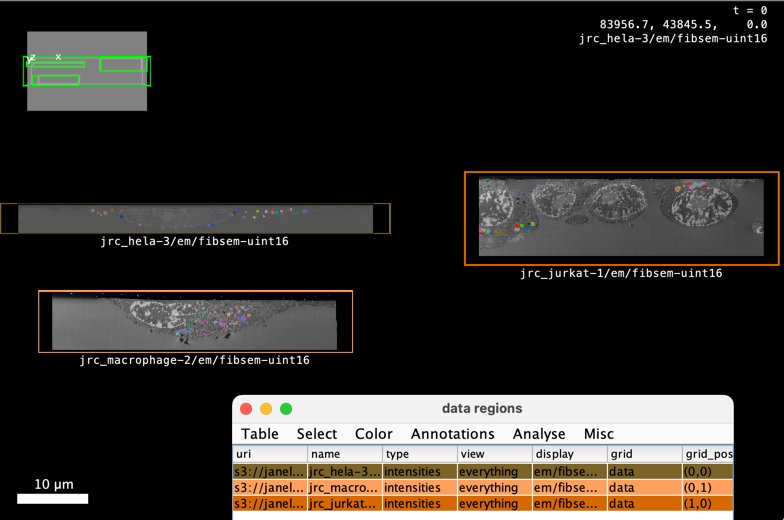
It is useful to visualise similar images in a grid view where all images are visible as “thumbnails”, which in the case of OME-Zarr can simply be the lowest resolution version of the data. Like this, users can have an overview of all the data and can then decide to “zoom in” on some datasets to explore them in higher resolution.
Implementations of this concept include:
For example, this table defines a MoBIE grid view of three OpenOrganelle vEM images along with label images of mitochondria segmentation. It can be opened in MoBIE via the “Open Simple Collection Table” menu entry:
Proposal#
tl;dr#
Node interface: a consistent JSON structure for several different types of OME-Zarr metadata object, where fields specific to the node type are inside an attributes field, and the root only stores information used for identifying and referencing the object.
Collections: arbitrary collections of nodes which can be specialised for different use cases.
Reworking existing structures to a Node/Collection-based framework:
Single-scale image arrays
Multiscale image groups, bioformats2raw.layout
Reference interface: a consistent system for referring to local and remote OME-Zarr metadata objects
Extension system: namespacing within Nodes’ types and fields within their attributes to allow extension of the OME-Zarr by specific vendors or for specific use cases
Integration of coordinate transformations (RFC-5) metadata
Intro#
This proposal adds collections to the OME-Zarr specification. “Collections” are groupings of “nodes”. Nodes represent OME-Zarr images (multiscales, singlescales) or collections, either inline or via a path reference. Nested collections and multiscales can be inlined in the metadata. Nodes reference images or collections that are stored locally relative to the collection or remotely (using URLs). Arbitrary user or implementation metadata may be added to collections or nodes, which is an opportunity to add metadata that is only valid for a node in the context of a collection (e.g. rendering settings). Images may be added as nodes to multiple collections.
Goals#
Define a mechanism for grouping images into (hierarchical) collections
Define a mechanism for referencing components of a collection (nodes, coordinate systems etc) internally and externally
Add extensibility to collections for user/implementation-specific metadata and new node types
Make a new home for HCS, bioformats2raw.layout, labels and scene metadata
Incorporate coordinate systems and transformations
Metadata#
Node#
This RFC defines a basic interface for an OME-Zarr metadata object, which we name Node.
Objects that implement Node have the following fields:
Field |
Type |
Required? |
Notes |
|---|---|---|---|
|
string |
yes |
Value MUST be a string identifying the node type. |
|
string |
no |
Value MUST be a string that matches |
|
string |
yes |
Value MUST be a non-empty string intended for human-readable display. Names MUST be unique within the enclosing collection. |
|
object |
no |
Value MUST be a dictionary. See attributes section |
The type field of a Node defines the additional fields, if any, it has.
This RFC defines three Node types: Collection, Multiscale, and Singlescale.
Future RFCs might add more Node types, including custom Node types.
A Node object may be used as the root object of the ome key, in which case a version field, as defined in previous spec versions, is also required.
Non-root Node objects SHOULD NOT have a version field and MUST NOT have a different version value than the root Node.
Collection node#
A Collection node groups together one or more Nodes.
Collections MAY be nested.
Field |
Type |
Required? |
Notes |
|---|---|---|---|
|
string |
yes |
Value MUST be |
|
string |
no |
Value MUST be a string that matches |
|
string |
yes |
Value MUST be a non-empty string intended for human-readable display. Names MUST be unique within the enclosing collection. |
|
array |
no |
Value MUST be an array of |
|
object |
no |
Value MUST be a |
|
object |
no |
Value MUST be a dictionary. See attributes section. |
Either "nodes" or "path" MUST be present, but not both.
Multiscale node#
A Multiscale node represents an OME-Zarr multiscale image.
This new interface replaces the multiscale metadata defined in the previous versions of the OME-Zarr specification.
Field |
Type |
Required? |
Notes |
|---|---|---|---|
|
string |
yes |
Value MUST be |
|
string |
no |
Value MUST be a string that matches |
|
string |
yes |
Value MUST be a non-empty string intended for human-readable display. Names MUST be unique within the enclosing collection. |
|
array |
no |
Value MUST be an array of |
|
object |
no |
Value MUST be a |
|
object |
yes |
Value MUST be a dictionary. See attributes section. Required because it MUST contain |
Either "nodes" or "path" MUST be present, but not both.
Singlescale node#
A Singlescale node represents one resolution level of an OME-Zarr multiscale image.
This new interface replaces the dataset metadata defined in the previous versions of the OME-Zarr specification.
Field |
Type |
Required? |
Notes |
|---|---|---|---|
|
string |
yes |
Value MUST be |
|
string |
no |
Value MUST be a string that matches |
|
string |
yes |
Value MUST be a non-empty string intended for human-readable display. Names MUST be unique within the enclosing collection. |
|
object |
no |
Value MUST be a |
|
object |
yes |
Value MUST be a dictionary. See attributes section. Required because it MUST contain |
Singlescale nodes represent resolution levels within a multiscale pyramid.
Singlescale nodes MUST have a coordinateTransformations key in their attributes, which
is an array of transformation objects, that conform to the coordinate transformations specification
contain and only contain a single
scaletransformation, or asequenceof ascaletransformation followed by atranslationtransformation.The
inputfield of these transformations references theidof theSinglescalenode itself.The
outputfield references theidof a coordinate system defined undercoordinateSystemsin aMultiscalenode.
Path interface#
This new interface replaces the paths defined in the previous versions of the OME-Zarr specification.
Field |
Type |
Required? |
Notes |
|---|---|---|---|
|
string |
yes |
Value MUST be a valid path type. |
|
string |
yes |
Value MUST be a string containing a path. See below. |
The type field defines how the path is interpreted.
Currently, the zarr and json types are supported.
The
"zarr"type is used for paths that reference nodes in a Zarr array or group. Implementations MUST appendzarr.jsonto the path to access the metadata of the referenced node.The
"json"type is used for paths that reference nodes in a JSON file.
The path string can be one of the following types:
Relative paths. To reference nodes that are on the same file system namespace as the json file describing the collection, relative paths may be used. Relative paths are interpreted relative to the json file describing the collection. Relative paths follow the relative path notation defined in IETF RFC1808. Briefly,
.and..are used to navigate the hierarchy and the hierarchy is separated by/. Relative paths may be used for data stored on traditional file systems as well as other storage protocols, such as HTTP or S3. Examples:./image.ome.zarr../image.ome.zarr
Absolute file paths. On traditional file systems, absolute paths may be used with the
filescheme as specified by IETF RFC8089. Please note that absolute file paths are generally not portable across operating systems or file systems. Examples:file:///home/user/data/image.ome.zarrfile://C:/Users/user/data/image.ome.zarr
HTTP(S) URLs. To reference nodes that are stored remotely, URLs with the
httporhttpsscheme may be used. URLs follow the notation defined in IETF RFC1738. Examples:https://example.com/image.ome.zarrhttp://example.com/image.ome.zarr
Future RFCs may propose additional path types, such as S3 URLs or chained paths (e.g. for referencing files within a zip file). See the Security section for guidance on access restrictions.
Reference interface#
Referenced objects MUST have an id field.
A reference MUST be an object with the following fields:
Field |
Type |
Required? |
Notes |
|---|---|---|---|
|
string |
yes |
Value MUST be a string that matches |
|
object |
no |
Value MUST be a |
For external references, the path field MUST be present.
Attributes#
Each Node has an attributes field that can be populated with JSON metadata.
A primary use case for the attributes field is the specialization of collections and nodes through additional metadata.
Attribute keys follow the naming scheme described in Extensibility: unprefixed keys are reserved for the core specification, while prefixed keys (e.g., mobie:, neuroglancer:, fractal:, webknossos:) allow custom metadata.
Custom-prefixed keys can also be used to add additional sub-keys or behavior to existing unprefixed keys.
This can be thought of as a way of achieving inheritance.
For example, the well key could be specialized by a fractal:well key that adds additional sub-keys or alters behavior.
It is out-of-scope of this RFC to fully define the inheritance behavior.
That is left to be defined on a case-by-case basis for individual key specifications and may be standardized in a future RFC.
Unprefixed attribute keys that are defined as part of this RFC are:
coordinateSystemscoordinateTransformationslabels, as well aslabelValueandcolorin label attributesplate,well,acquisitionfor HCS metadata
Extensibility#
Adding collections to OME-Zarr provides an opportunity to define extension points. Extension points allow the specification to be extended in a controlled manner, enabling custom functionality while maintaining interoperability.
Naming scheme#
Extension identifiers follow a prefixed vs unprefixed convention:
Unprefixed identifiers are reserved for the core specification and can only be added or modified through the RFC process.
Prefixed identifiers (separated by
:) can be freely introduced by custom extensions without requiring an RFC. The prefix identifies the user or organization that introduces and maintains the extension. Prefixes SHOULD be registered in a central registry (a Github repository under theomeorganization). Registration of a prefix claims maintainership for that prefix and provides a discoverable location for the specification of custom extensions.The
ome:prefix is reserved for official extensions that have not yet been incorporated into the core specification.
This naming scheme applies uniformly to all extension points listed below.
Implementations SHOULD ignore extension identifiers they do not recognize, allowing graceful degradation when encountering unknown extensions.
Extension points#
The following extension points are defined:
Node types#
The type field of a Node defines its structure and semantics. This RFC defines three unprefixed node types: collection, multiscale, and singlescale. Custom extensions can add prefixed node types (e.g., mobie:table, fractal:roi).
Implementations that do not recognize a node type SHOULD treat it as an opaque node and MAY skip it or display it with a generic representation.
Attribute keys#
Attribute keys within the attributes dictionary of nodes are an extension point. Custom extensions can add prefixed keys (e.g., neuroglancer:shader, webknossos:settings). See Attributes for more details.
Path types#
The type field of a Path object defines how the path is interpreted. This RFC defines two unprefixed path types: zarr and json. Custom extensions can add prefixed path types for other storage protocols or access patterns (e.g., myorg:s3, myorg:zip).
Implementations that do not recognize a path type SHOULD treat the referenced node as opaque and MAY skip it or display it with a generic representation.
Coordinate transformation types#
The type field of a coordinate transformation defines its mathematical operation. RFC-5 defines several unprefixed transformation types including identity, scale, translation, and others. Custom extensions can add prefixed transformation types (e.g., myorg:nonlinear).
Implementations that do not recognize a transformation type SHOULD report an error or skip the transformation, as applying an unknown transformation could lead to incorrect spatial interpretation.
Coordinate system axis types#
The type field of an axis in a coordinate system defines its semantics. RFC-5 defines unprefixed axis types including space, time, and channel. Custom extensions can add prefixed axis types (e.g., myorg:wavelength).
Implementations that do not recognize an axis type MAY treat it as an opaque dimension.
Examples#
See more examples at https://github.com/normanrz/ngff-rfc8-collection-examples/.
A multiscale group with a single, inlined resolution level#
{
    "ome": {
        "version": "0.x",
        "type": "multiscale",
        "name": "multiscales_example",
        "id": "image_0",
        "nodes": [
          {
            "id": "s0",
            "name": "s0",
            "type": "singlescale",
            "path": {
              "type": "zarr",
              "path": "./s0"
            },
            "attributes": {
              "coordinateTransformations": [
                {
                  "type": "scale",
                  "scale": [1, 1, 1],
                  "input": {"id": "s0"},
                  "output": {"id": "physical"}
                }
              ]
            }
          }
        ],
        "attributes": {
          "coordinateSystems": [
            {
              "id": "physical",
              "axes": [...]
            }
          ]
        }
    }
}
A multiscale group with a single resolution level#
The multiscale group contains the following metadata:
{
    "ome": {
        "version": "0.x",
        "type": "multiscale",
        "name": "multiscales_example",
        "id": "image_0",
        "nodes": [
          {
            "id": "s0",
            "name": "s0",
            "type": "singlescale",
            "path": {
              "type": "zarr",
              "path": "./s0"
            },
          }
        ],
        "attributes": {
          "coordinateSystems": [
            {
              "id": "physical",
              "name": "The physical coordinate system",
              "axes": [...]
            }
          ]
        }
    }
}
And the zarr.json at the location of the resolution level (./s0/zarr.json) contains the following metadata:
{
    "ome": {
        "version": "0.x",
        "type": "singlescale",
        "name": "s0",
        "id": "s0",
        "attributes": {
          "coordinateTransformations": [
            {
              "type": "scale",
              "scale": [1, 1, 1],
              "input": {"id": "s0"},
              "output": {
                "id": "physical",
                "path": {
                  "type": "json",
                  "path": "../zarr.json"
                }
              }
            }
          ]
        }
    }
}
A collection with a multiscale and a nested collection#
{
    "ome": {
        "version": "0.x",
        "type": "collection",
        "name": "jrc_hela-1",
        "nodes": [
          {
            "name": "raw",
            "type": "multiscale",
            "path": {
              "type": "zarr",
              "path": "./raw", // a relative or absolute path
            },
            "attributes": {
                "example-viewer:settings": {
                    "isDisabled": true
                },
                ... // arbitrary user-defined metadata
            },
          },
          {
              "name": "nested_collection",
              "type": "collection",
              "path": {
                "type": "json",
                "path": "./nested_collection.json"
              }
          }, ...
        ],
        "attributes": {
            ...
        }
    }
}
A collection with an inlined multiscale#
{
    "ome": {
        "version": "0.x",
        "type": "collection",
        "name": "example",
        "nodes": [
          {
            "name": "raw",
            "id": "raw",
            "type": "multiscale",
            "nodes": [
              {
                "id": "raw_0",
                "name": "raw_0",
                "type": "singlescale",
                "path": {
                  "type": "zarr",
                  "path": "./raw/0"
                }
              }
            ],
            "attributes": {
              "coordinateTransformations": [
                {
                  "type": "scale",
                  "scale": [1, 1, 1],
                  "input": {"id": "raw_0"},
                  "output": {"id": "physical"}
                }
              ],
              "coordinateSystems": [
                {
                  "id": "physical",
                  "axes": [...]
                }
              ]
            }
          }
        ]
    }
}
A grid view gallery#
A gallery view could also be represented within the proposed collection JSON as shown in the below example.
Note that the grid view is modelled here as a collection of collections, where the collection at each grid position includes the raw EM image and the mitochondria segmentation label mask image.
Also note some MoBIE specific attributes:
"mobie:grid": "true"specifies that the data should be laid out in a grid.
{
    "ome": {
        "version": "0.x",
        "type": "collection",
        "name": "openorganelle-mito-gallery",
        "attributes": {
            "mobie:grid": "true"
        },
        "nodes": [
            {
                "name": "jrc_hela-3",
                "type": "collection",
                "nodes": [
                    {
                        "name": "fibsem-uint16",
                        "type": "multiscale",
                        "path": {
                          "type": "zarr",
                          "path": "https://janelia-cosem-datasets.s3.amazonaws.com/jrc_hela-3/jrc_hela-3.zarr/em/fibsem-uint16",
                        }
                    },
                    {
                        "name": "mito_seg",
                        "type": "multiscale",
                        "path": {
                          "type": "zarr",
                          "path": "https://janelia-cosem-datasets.s3.amazonaws.com/jrc_hela-3/jrc_hela-3.zarr/labels/mito_seg",
                        },
                        "attributes": {
                            "labels": {}
                        }
                    }
                ]
            },
            {
                "name": "jrc_macrophage-2",
                "type": "collection",
                "nodes": [
                    {
                        "name": "fibsem-uint16",
                        "type": "multiscale",
                        "path": {
                          "type": "zarr",
                          "path": "https://janelia-cosem-datasets.s3.amazonaws.com/jrc_macrophage-2/jrc_macrophage-2.zarr/em/fibsem-uint16"
                        }
                    },
                    {
                        "name": "mito_seg",
                        "type": "multiscale",
                        "path": {
                          "type": "zarr",
                          "path": "https://janelia-cosem-datasets.s3.amazonaws.com/jrc_macrophage-2/jrc_macrophage-2.zarr/labels/mito_seg"
                        },
                        "attributes": {
                            "labels": {}
                        }
                    }
                ]
            },
            {
                "name": "jrc_jurkat-1",
                "type": "collection",
                "nodes": [
                    {
                        "name": "fibsem-uint16",
                        "type": "multiscale",
                        "path": {
                          "type": "zarr",
                          "path": "https://janelia-cosem-datasets.s3.amazonaws.com/jrc_jurkat-1/jrc_jurkat-1.zarr/em/fibsem-uint16"
                        }
                    },
                    {
                        "name": "mito_seg",
                        "type": "multiscale",
                        "path": {
                          "type": "zarr",
                          "path": "https://janelia-cosem-datasets.s3.amazonaws.com/jrc_jurkat-1/jrc_jurkat-1.zarr/labels/mito_seg"
                        },
                        "attributes": {
                            "labels": {}
                        }
                    }
                ]
            }
        ]
    }
}
Label maps and other derived images#
Previous versions of the OME-Zarr specification defined a mechanism for associating label images with a single multiscale image.
This was achieved by using a labels Zarr group that had to be a direct child of the multiscale Zarr group with some specific metadata.
This proposal replaces this mechanism.
To denote a multiscale image as a label map, the labels attribute MUST be present.
If present, the value of the labels attribute MUST be an object with the following fields:
Field |
Type |
Required? |
Notes |
|---|---|---|---|
|
array of objects |
no |
Attributes for individual labels. Each object MUST be a |
|
array of strings |
no |
An array with |
Because no fields are required, an empty object MAY be used.
In this proposal, the previous colors and properties fields are combined into a single labelAttributes field.
The rgba field in the colors objects has been renamed to color.
Label Attributes interface#
The labelAttributes field is an array of objects with the following fields:
Field |
Type |
Required? |
Notes |
|---|---|---|---|
|
number |
yes |
Value MUST be the label value. |
|
array of number |
no |
Value MUST be a color in array format. |
If present, the color field MUST have an array with four integers between 0 and 255, inclusive. These integers represent the uint8 values of red, green, blue and alpha.
Additional keys MAY be added, following the attribute key naming rules.
The previous label-value key is now renamed to labelValue for consistency.
Example#
{
    "ome": {
        "version": "0.x",
        "type": "collection",
        "name": "label-example",
        "attributes": { ... },
        "nodes": [{
            "id": "raw",
            "name": "raw",
            "type": "multiscale",
            "nodes": [ ... ]
        }, {
            "name": "nuclei",
            "type": "multiscale",
            "nodes": [ ... ],
            "attributes": {
                "labels": {
                    "source": [ {"id": "raw"} ],
                    "labelAttributes": [{
                        "labelValue": 1,
                        "color": [ 255, 0, 0, 255 ]
                    }, {
                        "labelValue": 2,
                        "color": [ 0, 255, 0, 255 ]
                    }]
                }
            }
        }]
    }
}
High-content screening (HCS) metadata#
High-content screening data is typically organized as a grid of wells on a plate, where each well contains one or more multiscale images from one or more acquisition rounds. This section introduces additional metadata for organizing wells on a plate.
This proposal changes the HCS references from numeric IDs and names to string-based ID references, consistent with the References mechanism defined above.
Plate attribute#
A collection node representing a plate MUST have a plate attribute with the following fields:
Field |
Type |
Required? |
Notes |
|---|---|---|---|
|
array of objects |
no |
List of acquisitions performed on the plate. Each object MUST be |
|
array of objects |
yes |
List of columns in the plate. Each object MUST be |
|
array of objects |
yes |
List of rows in the plate. Each object MUST be |
Acquisition interface#
Field |
Type |
Required? |
Notes |
|---|---|---|---|
|
string |
yes |
Value MUST be a string that matches |
|
string |
no |
A human-readable name for the acquisition. |
Column interface#
Field |
Type |
Required? |
Notes |
|---|---|---|---|
|
string |
yes |
Value MUST be a string that matches |
|
string |
no |
A human-readable name for the acquisition. |
Row interface#
Field |
Type |
Required? |
Notes |
|---|---|---|---|
|
string |
yes |
Value MUST be a string that matches |
|
string |
no |
A human-readable name for the acquisition. |
Well attribute#
A collection node representing a well MUST have a well attribute with the following fields:
Acquisition attribute#
The acquisition attribute MUST be a Reference to one of the acquisitions.
It MAY be set on individual multiscale nodes within a well or on a collection sub-node grouping all images from a single acquisition.
We suggest two possible layouts for HCS data, which are not mutually exclusive and can be used in combination: a “wide” layout where all images are direct children of the well collection and a “tall” layout where images are grouped in sub-collections by acquisition.
Wide example (acquisitions flat in the well)#
In this layout, all multiscale nodes are direct children of the well collection.
Each node carries an acquisition attribute.
Derived images such as label maps are siblings of their source image and can still be linked via the source reference in their labels attribute. This layout is more compact but can become cluttered when there are multiple acquisitions and derived nodes.
{
    "ome": {
        "version": "0.x",
        "type": "collection",
        "name": "hcs-plate-001",
        "attributes": {
            "plate": {
                "acquisitions": [
                    {
                        "id": "acq_0",
                        "name": "Acquisition Round 1"
                    }
                ],
                "columns": [
                    {
                        "id": "1",
                        "name": "1"
                    }
                ],
                "rows": [
                    {
                        "id": "A",
                        "name": "A"
                    }
                ]
            }
        },
        "nodes": [
            {
                "type": "collection",
                "name": "well A01",
                "attributes": {
                    "well": {
                        "column": {"id": "1"},
                        "row": {"id": "A"}
                    }
                },
                "nodes": [
                    {
                        "id": "A01_0",
                        "type": "multiscale",
                        "name": "A01_0",
                        "path": {
                            "type": "zarr",
                            "path": "./A/01/001.img"
                        },
                        "attributes": {
                            "acquisition": {"id": "acq_0"}
                        }
                    },
                    {
                        "type": "multiscale",
                        "name": "A01_0_ill_corrected",
                        "path": {
                            "type": "zarr",
                            "path": "./A/01/001_ill_corrected.img"
                        },
                        "attributes": {
                            "acquisition": {"id": "acq_0"},
                            "source": [{"id": "A01_0"}]
                        }
                    },
                    {
                        "type": "multiscale",
                        "name": "A01_0_nuclei",
                        "path": {
                            "type": "zarr",
                            "path": "./A/01/001_nuclei.img"
                        },
                        "attributes": {
                            "acquisition": {"id": "acq_0"},
                            "labels": {
                              "source": [{"id": "A01_0"}]
                            }
                        }
                    }
                ]
            }
        ]
    }
}
Tall example (acquisitions as sub-collections)#
In this layout, each acquisition is wrapped in a sub-collection inside the well.
The acquisition attribute is set on the sub-collection rather than on individual nodes.
This serves as an example that wells can consist of collections, not just multiscales.
{
    "ome": {
        "version": "0.x",
        "type": "collection",
        "name": "hcs-plate-001",
        "attributes": {
            "plate": {
                "acquisitions": [
                    {
                        "id": "acq_0",
                        "name": "Acquisition Round 1"
                    },
                    {
                        "id": "acq_1",
                        "name": "Acquisition Round 2"
                    }
                ],
                "columns": [
                    {
                        "id": "1",
                        "name": "1"
                    }
                ],
                "rows": [
                    {
                        "id": "A",
                        "name": "A"
                    }
                ]
            }
        },
        "nodes": [
            {
                "type": "collection",
                "name": "well A01",
                "attributes": {
                    "well": {
                        "column": {"id": "1"},
                        "row": {"id": "A"}
                    }
                },
                "nodes": [
                    {
                        "type": "collection",
                        "name": "A01_acq0",
                        "attributes": {
                            "acquisition": {"id": "acq_0"}
                        },
                        "nodes": [
                            {
                                "id": "A01_0",
                                "type": "multiscale",
                                "name": "A01_0",
                                "path": {
                                    "type": "zarr",
                                    "path": "./A/01/001.img"
                                }
                            },
                            {
                                "type": "multiscale",
                                "name": "A01_0_nuclei",
                                "path": {
                                    "type": "zarr",
                                    "path": "./A/01/001_nuclei.img"
                                },
                                "attributes": {
                                    "labels": {
                                        "source": ["A01_0"]
                                    }
                                }
                            }
                        ]
                    },
                    {
                        "type": "collection",
                        "name": "A01_acq1",
                        "attributes": {
                            "acquisition": {"id": "acq_1"}
                        },
                        "nodes": [
                            {
                                "id": "A01_1",
                                "type": "multiscale",
                                "name": "A01_1",
                                "path": {
                                    "type": "zarr",
                                    "path": "./A/01/002.img"
                                }
                            },
                            {
                                "type": "multiscale",
                                "name": "A01_1_nuclei",
                                "path": {
                                    "type": "zarr",
                                    "path": "./A/01/002_nuclei.img"
                                },
                                "attributes": {
                                    "labels": {
                                        "source": [{"id": "A01_1"}]
                                    }
                                }
                            }
                        ]
                    }
                ]
            }
        ]
    }
}
While inlined plate collections are shown above for simplicity, an on-disk plate collection could still refer to separate on-disk collections within each well that carry a well attribute.
bioformats2raw.layout metadata#
The bioformats2raw.layout metadata is replaced by this proposal.
A series of images can now be represented as a collection of multiscale images.
Coordinate transformations#
Coordinate systems and transformations can be stored in two distinct locations:
For single multiscale or singlescale images, they can be stored in the
omekey of theattributescontainer in azarr.jsonfile of the multiscales zarr group.For collections of two or more images in a common coordinate system, RFC-5 defines a parent-level metadata format. In this layout,
coordinateTransformationsdefine relationships between differentcoordinateSystems, which may be associated to multiscale images:
{
  "coordinateTransformations": [
    {
      "type": "translation",
      "translation": [0, 0, 100],
      "input": {"id": "physical", "path": "./image_1"}, // references collection node ID
      "output": {"id": "world"} // references coordinate system ID
    }
  ]
}
In a change from the previous specification, coordinate systems are referenced using the Reference mechanism, i.e. via IDs, and not via names.
{
  "ome": {
    "version": "0.x",
    "type": "collection",
    "name": "Tiles",
    "id": "tiles",
    "attributes": {
      "scene": {
        "coordinateSystems": [
          {
            "id": "world",
            "axes": [...]
          }
        ],
        "coordinateTransformations": [
          {
            "type": "translation",
            "translation": [0, 0, 100],
            "input": {
              "path": {
                "type": "zarr",
                "path": "./tile_0.zarr"
              },
              "id": "physical"
            },  // references coordinate system "physical" defined in tile_0
            "output": {"id": "world"}  // references coordinate system "world" defined in same node
          },
          {
            "type": "translation",
            "translation": [100, 0, 0],
            "input": {
              "path": {
                "type": "zarr",
                "path": "./tile_1.zarr"
              },
              "id": "physical"
            },  // references coordinate system "physical" defined in tile_1
            "output": {"id": "world"}  // references coordinate system "world" defined in same node
          }
        ]
      }
    },
    "nodes": [
      {
        "type": "multiscale",
        "id": "tile_0",
        "name": "Tile 0",
        "path": {
          "type": "zarr",
          "path": "./tile_0.zarr"
        }
      },
      {
        "type": "multiscale",
        "id": "tile_1",
        "name": "Tile 1",
        "path": {
          "type": "zarr",
          "path": "./tile_1.zarr"
        }
      }
    ]
  }
}
Coordinate System interface#
The Coordinate System objects have the following fields:
Field |
Type |
Required? |
Notes |
|---|---|---|---|
|
string |
yes |
Value MUST be a string that matches |
|
string |
no |
More descriptive name for the coordinate system, if needed. |
|
array of strings |
yes |
Value MUST be an array of axes, as defined in RFC-5. |
Coordinate Transformation interface#
The Coordinate Transformation objects have the following fields:
Field |
Type |
Required? |
Notes |
|---|---|---|---|
|
string |
yes |
Value MUST be a valid coordinate transform type, as defined in RFC-5. |
|
object |
yes |
Value MUST be a |
|
object |
yes |
Value MUST be a |
Additional fields MAY be added as required by the transform type.
Depending on the context, different fields are required:
Context |
|
|
|---|---|---|
scene |
{“id”: “imageA”, “name”: “physical” } |
{ “id”: “imageB”, “name”: “physical” } |
Multiscale > attributes > coordinateTransformations |
{ “id”: “scale0”} |
{ “id”: “image”, “name”: “physical” } |
Multiscale > attributes > coordinateTransformations: In the context of multiscales transformations, the following requirements apply:
The
inputfield MUST reference a singlescale node.The
idfield MUST be present.The
pathfield MAY be omitted or null.The
outputfields of all transformations MUST reference the same coordinate system via theidfield.
Node/Multiscales > attributes > scene > coordinateTransformations: In the context of node-level transformations between different multiscale collections, the following requirements apply:
The
inputfield MUST reference a coordinate system via theidfield.The
outputfield MUST reference a coordinate system via theidfield.If the referenced coordinate system is in the same metadata document, the
pathfield MAY be omitted or null. If the referenced coordinate system is in a different metadata document, both theidandpathfields MUST be present.
Scene attribute#
The scene attribute MUST be an object with the following fields:
Field |
Type |
Required? |
Notes |
|---|---|---|---|
|
array |
no |
Values MUST be valid instances of |
|
array |
yes |
Values MUST be valid instances of |
A scene metadata object can be defined in the attributes of a collection to enrich the collection with spatial information of the nodes within the collection.
The scene field allows to clearly distinguish between the spatial information pertaining to an individual multiscale image (which is stored in the attributes of the multiscale)
and the spatial information pertaining to the collection of images (which is stored in the attributes of the collection).
Metadata storage#
OME-Zarr group#
Collection metadata may be stored in the ome key of the attributes container in a zarr.json file of a Zarr group.
This is particularly useful for defining the nodes that are stored within a Zarr group. However, there is no limitation to only reference nodes within the Zarr group.
{
    "zarr_format": 3,
    "node_type": "group",
    "attributes": {
        "ome": {
            "version": "0.x",
            "type": "collection",
            "name": "zarr.json-example",
            "nodes": [{
                "type": "multiscale",
                "name": "image1",
                "path": {
                  "type": "zarr",
                  "path": "./image1.img.zarr"  // reference to a Zarr group
                }
            }, ...]
        }
    }
}
Standalone JSON#
Collection metadata may also be stored in standalone JSON files that are stored in arbitrary locations and have a file name ending in .json.
Here, the metadata is stored in the ome key of the root object.
Standalone files are useful for persisting groupings of images that may or may not be stored in the same folder hierarchy.
{
    "ome": {
        "version": "0.x",
        "type": "collection",
        "name": "standalone-example",
        "nodes": [{
            "type": "multiscale",
            "name": "image1",
            "path": {
              "type": "zarr",
              "path": "https://example.com/image1.img.zarr"
            }
        }, ...]
    }
}
Requirements#
The key words “MUST”, “MUST NOT”, “REQUIRED”, “SHALL”, “SHALL NOT”, “SHOULD”, “SHOULD NOT”, “RECOMMENDED”, “MAY”, and “OPTIONAL” in this document are to be interpreted as described in IETF RFC 2119
Stakeholders#
Visualization developers
Data management developers
Image Archives
Workflow developers
Implementation#
This RFC has not been implemented yet.
However, several visualization tools already have support for showing multiple images in the same view, see “Prior art and references”. Adopting this new metadata format is achievable with reasonable effort.
It is also expected that programming libraries will support this new metadata format to construct and inspect collections.
Drawbacks, risks, alternatives, and unknowns#
This RFC adds breaking changes that are neither backwards nor forwards compatible, which presents additional complexity to implementations and users.
Defining a custom format instead of reusing existing validated formats introduces risk of design errors.
Redundant metadata#
This RFC introduces the possibility for redundant metadata. For example, a collection can contain inlined metadata for multiscale images and the multiscale images can also be specified in standalone metadata. This redundant metadata can go out of sync. It is the responsibility of implementations to ensure consistency where required.
For reading, implementations SHOULD parse the metadata as available to the implementation from the user-supplied entry point in the OME-Zarr hierarchy.
New Multiscale/Singlescale metadata#
In an effort to unify the existing and new collection types of OME-Zarr, the Multiscale metadata has been changed to mirror the Collection metadata. Still, it is a specialized node type because of its prevalence and semantic requirements with regards to its Singlescale children nodes. The Singlescale metadata has been elevated to a first-class node type. This also allows specifying images that only contain a single resolution level.
These changes are breaking changes to the core of the OME-Zarr specification.
Abandoned Ideas#
RO Crate#
Instead of defining a custom collection format for OME-Zarr, existing collection formats, such as RO Crate, could be utilized.
Research Object Crate (“RO Crate”) is a standard format that utilizes JSON-LD to define collections of research artifacts as well as their relationships and other metadata. Utilizing RO Crate for OME-Zarr collections would allow building upon an existing standard that has been validated in the field. Additionally, it would allow to easily integrate with other research artifacts, such as publications, talks, protocols, etc.
RO Crate imposes very strict requirements around its metadata. Every key in a metadata object needs to be backed by a well-defined schema. While very precise, this presents burdens for adding user-defined metadata.
All the metadata in RO Crate is normalized and hierarchies or relationships are maintained via IDs. This is a common approach in database systems design. However, it leads to metadata files which are very hard to read by humans. This practically necessitates the use of libraries to inspect the metadata, which contradicts a design guideline of Zarr and OME-Zarr.
This RFC proposes adopting a simpler collection specification for OME-Zarr. RO Crate can still be used alongside collections or images to define metadata and integrate with other research objects.
JSONLD#
The RFC explored the possibility of using JSON-LD as the basis for the collection metadata format.
JSON-LD is a W3C standard for linked data that extends JSON with a @context mechanism for defining vocabularies, making JSON documents interoperable with semantic web tools.
Benefits#
JSON-LD is a widely used and well-supported standard with broad tooling support.
It provides a standardized type system via @type, which maps types to IRIs for global uniqueness and is backed by standard validation tooling.
It has built-in support for defining and referencing objects via @id, with JSON-LD processors understanding which properties are references versus literals.
Extensibility is handled through contexts: custom vocabularies can be published at URLs and reused across documents, which would eliminate the need for a custom prefix registry.
Namespace management via prefixes (e.g., mobie:grid) clearly distinguishes custom terms from core terms and prevents naming collisions between organizations extending the format.
The planned approach would have replaced the type and id fields with @type and @id, and added a @context field inside the ome object referencing a versioned context URL (e.g., https://ngff.openmicroscopy.org/0.x/context.jsonld).
Custom extensions would define their namespace in the context array, removing the need for a central prefix registry.
Internal references (e.g., for input, output, source) would use proper JSON-LD semantics via context definitions, allowing string values to be interpreted as references to @id values.
Downsides#
The core problem with JSON-LD for this RFC is that it is based on IRIs, which makes path-based references difficult.
Standard JSON-LD linking does not support relative paths (e.g., ./image.zarr) or file system paths.
It also does not support the typed path mechanism—distinguishing between zarr and json path types—that is a central part of this RFC.
This would force a hybrid approach where the Path interface uses JSON-LD syntax (@type) but does not conform to JSON-LD semantics.
Such a hybrid approach introduces its own complexity.
Users familiar with JSON-LD would expect standard linking to work, but our custom Path mechanism is not standard JSON-LD.
Generic JSON-LD processors would not understand the custom path mechanism and would not be able to fully process the metadata.
The benefit of reusing existing JSON-LD tooling would thus be largely negated.
To keep complexity manageable, we would need to heavily restrict which parts of JSON-LD are allowed. This creates a lose-lose situation: JSON-LD experts may be confused by the deviations from standard JSON-LD, while users unfamiliar with JSON-LD would still need to learn both JSON-LD concepts and the OME-NGFF-specific extensions. The learning curve would be higher than with a purpose-built format, without corresponding benefits in return.
For these reasons, the RFC adopts a simpler custom format with a prefix-based naming scheme instead of JSON-LD.
Prior art and references#
Initial Github issue#
Initial discussions started here: https://github.com/ome/ngff/issues/31
Neuroglancer JSON#
See https://neuroglancer-docs.web.app/json/api/index.html
JSON example
Shortened version from https://fafb-ffn1.storage.googleapis.com/landing.html
{
  "dimensions": {
    "x": [
      4e-9,
      "m"
    ],
    "y": [
      4e-9,
      "m"
    ],
    "z": [
      4e-8,
      "m"
    ]
  },
  "position": [
    109421.8984375,
    41044.6796875,
    5417
  ],
  "crossSectionScale": 2.1875,
  "projectionOrientation": [
    -0.08939177542924881,
    -0.9848012924194336,
    -0.07470247149467468,
    0.12882165610790253
  ],
  "projectionScale": 27773.019357116023,
  "layers": [
    {
      "type": "image",
      "source": {
        "url": "precomputed://gs://neuroglancer-fafb-data/fafb_v14/fafb_v14_orig"
      },
      "blend": "default",
      "name": "fafb_v14",
      "visible": false
    },
    {
      "type": "image",
      "source": {
        "url": "precomputed://gs://neuroglancer-fafb-data/fafb_v14/fafb_v14_clahe"
      },
      "blend": "default",
      "name": "fafb_v14_clahe"
    },
    {
      "type": "segmentation",
      "source": {
        "url": "precomputed://gs://fafb-ffn1-20190805/segmentation"
      },
      "segments": [
        "710435991"
      ],
      "skeletonRendering": {
        "mode2d": "lines_and_points",
        "mode3d": "lines"
      },
      "name": "fafb-ffn1-20190805"
    },
    ...
  ],
  "showAxisLines": false,
  "showSlices": false,
  "layout": "xy-3d"
}
MoBIE collections#
The MoBIE collection table allows users to specify a collection of images and segmentations (label mask images) and configure their rendering.
Each row in the table corresponds to one (single-channel) image or segmentation.
To open multi-channel images the image URI must be added several times and a channel column must be added to specify which channel to load.
One can specify an affine transformation for each image.
One can configure a grid layout to render multiple images side-by-side.
The same image can be opened multiple times, with different rendering settings or different transformations.
Webknossos datasource-properties.json#
Webknossos uses a JSON format to define “datasets”, which is a non-nestable collection of images with some metadata attached. It mirrors some of the OME-Zarr multiscale metadata for compatibility reasons.
JSON example
{
  "id": {
    "name": "l4_sample3",
    "team": ""
  },
  "dataLayers": [
    {
      "name": "color",
      "category": "color",
      "boundingBox": {
        "topLeft": [
          3072,
          3072,
          512
        ],
        "width": 1024,
        "height": 1024,
        "depth": 1024
      },
      "elementClass": "uint8",
      "mags": [
        {
          "mag": [
            1,
            1,
            1
          ],
          "path": "./color/1",
          "axisOrder": {
            "x": 1,
            "y": 2,
            "z": 3,
            "c": 0
          },
          "channelIndex": 0
        },
        {
          "mag": [
            2,
            2,
            1
          ],
          "path": "./color/2-2-1",
          "axisOrder": {
            "x": 1,
            "y": 2,
            "z": 3,
            "c": 0
          },
          "channelIndex": 0
        }
      ],
      "numChannels": 1,
      "dataFormat": "zarr"
    },
    {
      "name": "segmentation",
      "boundingBox": {
        "topLeft": [
          3072,
          3072,
          512
        ],
        "width": 1024,
        "height": 1024,
        "depth": 1024
      },
      "elementClass": "uint32",
      "mags": [
        {
          "mag": [
            1,
            1,
            1
          ],
          "path": "./segmentation/1",
          "axisOrder": {
            "x": 1,
            "y": 2,
            "z": 3,
            "c": 0
          },
          "channelIndex": 0
        },
        {
          "mag": [
            2,
            2,
            1
          ],
          "path": "./segmentation/2-2-1",
          "axisOrder": {
            "x": 1,
            "y": 2,
            "z": 3,
            "c": 0
          },
          "channelIndex": 0
        }
      ],
      "largestSegmentId": 2504697,
      "numChannels": 1,
      "dataFormat": "zarr",
      "category": "segmentation"
    }
  ],
  "scale": {
    "factor": [
      11.24,
      11.24,
      28
    ],
    "unit": "nanometer"
  }
}
STAC#
from the Geo Community https://stacindex.org/ https://stacspec.org/
BIDS#
https://direct.mit.edu/imag/article/doi/10.1162/imag_a_00103/119672/The-Past-Present-and-Future-of-the-Brain-Imaging
https://github.com/bids-standard/bids-specification-pdf-releases/blob/1.10.0/bids-spec.pdf
People worked on getting ome-zarr into BIDS https://github.com/bids-standard/bids-examples/tree/master/micr_XPCTzarr
OMERO.figure#
OMERO.figure uses a JSON file to specify the layout and rendering settings for images, as well as some info on page(s) layout. Until now, these images are hosted and rendered by OMERO, but support for OME-Zarr images is underway at https://github.com/ome/omero-figure/pull/619. Here, the OMERO Image ID is replaced by an OME-Zarr URL and rendering happens in the browser. See the demo.
The OMERO.figure json format is described here.
JSON example
Shortened version from https://gist.githubusercontent.com/will-moore/fe0e260544b46af6e1e523b288fc85bc/raw/30547e61d4d8753ef0016f0a70435f1aafb43c2f/OMERO.figure_NGFF_demo.json
{
    "panels": [
        {
            "x": 32.776939633609516,
            "y": 299.60384546911166,
            "width": 157,
            "height": 160.5839416058394,
            "zoom": 100,
            "dx": 0,
            "dy": 0,
            "labels": [],
            "deltaT": [],
            "rotation": 0,
            "selected": false,
            "pixel_size_x_symbol": "µm",
            "pixel_size_x_unit": "MICROMETER",
            "rotation_symbol": "°",
            "max_export_dpi": 1000,
            "vertical_flip": false,
            "horizontal_flip": false,
            "imageId": "https://uk1s3.embassy.ebi.ac.uk/idr/zarr/v0.4/idr0062A/6001240.zarr",
            "name": "6001240.zarr",
            "sizeZ": 236,
            "theZ": 118,
            "sizeT": 1,
            "theT": 0,
            "channels": [
                {
                    "active": true,
                    "coefficient": 1,
                    "color": "0000FF",
                    "family": "linear",
                    "inverted": false,
                    "label": "LaminB1",
                    "window": {
                        "end": 1500,
                        "max": 65535,
                        "min": 0,
                        "start": 0
                    }
                },
                {
                    "active": true,
                    "coefficient": 1,
                    "color": "FFFF00",
                    "family": "linear",
                    "inverted": false,
                    "label": "Dapi",
                    "window": {
                        "end": 1500,
                        "max": 65535,
                        "min": 0,
                        "start": 0
                    }
                }
            ],
            "orig_width": 271,
            "orig_height": 275,
            "pixelsType": "uint16",
            "zarr": {
                // consolidate zarr metadata here
            }
        }
    ]
}
Future possibilities#
The collections mechanism is a possibility for extending OME-Zarr in a backwards-compatible manner.
Future additions include:
Additional node types, such as tables, meshes
Additional path types, such as S3 URLs
Within the collections proposal, there are also opportunities for standardizing further metadata:
Rendering state
Expressing relationships between nodes in a collection
Future work:
Defining formal mechanism for extensions
Implementing the URL pipeline specification proposed by Jeremy Maitin-Shephard
Performance#
Multiple requests to collect metadata. Assembling a collection from path-referenced nodes requires one metadata request per node (fetching the zarr.json of each referenced Zarr group or the standalone JSON file). For large collections or high-latency storage backends (e.g. S3, HTTP), this can result in significant startup latency. Implementations MAY mitigate this by fetching node metadata in parallel and SHOULD consider caching resolved node metadata. Future RFCs may introduce a consolidated metadata format to reduce round trips.
Compatibility#
Backwards compatible#
This proposal deprecates the labels, HCS and bioformats2raw.layout parts of the OME-Zarr specification. The core multiscale metadata is unchanged and remains backwards compatible. Existing images can be wrapped in collections with additional metadata attached.
Forward compatible#
Existing implementations need to be updated to be able to understand the new collection objects.
Testing#
As part of the changes to the OME-Zarr specification, JSON schema files will be provided that can be used to validate collections metadata. Additional link checkers can be used to verify the existence and validity of nodes.
Tutorials and Examples#
Additional considerations#
Security#
This proposal allows collection metadata to reference arbitrary paths, including relative paths, absolute file system paths, and remote URLs. This introduces several security considerations that implementations MUST address.
Path traversal. Relative paths (e.g. ../../sensitive/data) may be used to reference files outside the intended storage scope.
Implementations SHOULD validate that resolved paths remain within an expected root directory or storage namespace, and MUST NOT follow paths that escape a defined sandbox without explicit user consent.
Server-side request forgery (SSRF). Remote URLs (HTTP/HTTPS) embedded in collection metadata may cause implementations to issue requests to unintended or internal network endpoints. Implementations SHOULD restrict which hosts or URL schemes are permitted, and SHOULD NOT automatically fetch remote paths without user awareness.
Confused deputy / cross-origin data access. A collection file from one origin may reference data from another origin. Implementations SHOULD apply appropriate same-origin or cross-origin access controls and MUST communicate to the user when data is being loaded from a different origin than the collection itself.
Untrusted collection files. Collection metadata read from untrusted sources (e.g. files downloaded from the internet, shared links) may contain malicious paths. Implementations SHOULD treat collection files from untrusted sources with caution, ideally prompting the user before resolving any external or absolute paths.
User communication. Clients SHOULD clearly indicate to the user which remote or external paths are being accessed as a result of loading a collection, so that users can make informed decisions about data access and privacy.
Socialization#
Github issue
OME-NGFF community meeting April 2024
https://docs.google.com/presentation/d/1ANsNdCchmwWR1grhg5-hSrWH5nyPz2QSFYToF56PVc4/edit#slide=id.g2c639a0285f_0_40
OME meeting 2024 in Dundee
I2K 2024 in Milan
OME-NGFF hackathon Zurich 2024
https://hackmd.io/OeY6A-ysQQu_NZuG7a-cXQ
Volume EM GRC Barcelona 2025
OME-NGFF community meeting June 2025
OME-NGFF hackathon Zurich 2025
OME meeting 2026 in Düsseldorf